Let's Partner Into Prosperity

Photo by Viewminder.
Most business partnerships are a waste of time. Guy Kawasaki says so, Paul Graham says so (see the section at the bottom), and I have learned from personal advice that both men speak truth. The thing is, partnering is most appealing and dangerous to a startup early on. In those critical months and years where credibility is scarce, partnerships seem to offer a quick path to legitimacy and (your partner will lead you to believe) wealth. So it's imperative to develop resistance and skepticism to partnership offers. But how?
Well, one method stumbled right into my lap recently. This is a spam message that I received last week:
"LET'S PARTNER INTO PROSPERITY: Kudos!!! You've got a very good work going here. I've been contracted to develop a website and a phone application that can help people in a particular Country to learn their three different dialects. It's a multimillion $ Project to be funded by the Government. I understand that a lot of scamming bullshit is going on online but you won't need to spend a dime of yours, all we need is the service of a person that has the knowledge required which would be magnanimously remunerated. I don't know much about language software design, if you do or if you know anyone that can partner with me on this please mail me now without any delay: address@yahoo.com Do you have a website? If yes, what's your website? I'm waiting ... Success!!!"
It's got all the elements of a bad partnership: vague intentions, an appeal to the legitimacy of some large organization (the Government!), a nod to skeptics, and call to action. My advice to you: the next time someone proposes a partnership, simply tack "... Success!!!" to what they say to remind yourself that most partnerships are a waste of time. What's scary is that many seemingly legitimate partnership offers are more dangerous than this example because they lure you into wasting time on them. At least in this case I can just click delete and get on with my day.
Why You Can't Admit Personal Mistakes on the Internet

Photo by Robert Couse-Baker.
My uncle is an entrepreneur-turned-corporate executive and has achieved considerable career success in his life, which is just to say that he's imposing and has a track record of getting what he wants.
One summer between my junior and senior years of college he hired me to help landscape his lawn. Several weeks after I had started, I made a small mistake.
"Oh, sorry about that, I'll just --"
"George, never say you're sorry" he said.
"Sure, I just meant that --"
"I know what you meant, but never say sorry, it makes you appear weak. Instead of saying you're sorry, fix the problem." He paused for a moment, looking at me, and then went back inside.
His advice ran so counter to what I had been taught that it stuck in my memory. I had always been taught to admit mistakes and correct them, but here he was suggesting I skip the first step. I'm still not sure I agree with it completely, but like every good over-generalization it has a nugget of truth: admitting a personal blunder to someone who has no empathy for you is ill-advised. That summer was all about me becoming employable, so I'm pretty sure my uncle meant that I would appear weak to a boss or employer, but the rule holds doubly-true for internet readers.
In the past, I have been tempted to write blogs about my goof-ups. I have almost always decided not to write such posts, not for want of subject material, but because they don't have any upside for me or my company. In the best case, people will think I'm humble, in the worst case they will think I'm incompetent. Simply put, I'm not willing to risk being labeled the latter for the former. And neither should you.
Self-aware people admit failure to get constructive criticism and seek catharsis. You aren't likely to get either if you bare your soul to the anonymous masses on the internet by first saying "I'm sorry."
Hypothetical Number Inflation

Photo by Steve Jurvetson.
I read a lot of Hacker News and it always strikes how big the numbers are in other people's blog posts. When people write about a big exit on HN, they talk about $100M not $500,000.
When I was in college, and especially when I was running my first startup, reading those articles made me feel like a failure. From what I could tell, the world was populated exclusively by companies "struggling" to break $10M in yearly sales, and founders learning how to manage similarly "modest" liquidity events.
Now that I've been blogging for a few years, I can say from experience that most of those numbers are bogus. Survivorship bias aside, bloggers suffer from what I like to call Hypothetical Number Inflation.
When I write about a topic, I want to make a point, and the point is very rarely to be realistic about ordinary business metrics. I might want to prove that the relationship between effort and reward is correlative not causative, or that bootstrapping your first business makes sense. These are opinions that I've thought through and believe, but it helps to rally some ballpark numbers to make the case.
And therein lies the problem: in the course of arguing a point, it behooves me as a writer to push my numbers to the logical extreme to avoid losing my readers to unrelated quantitative niggling.
If I want to provide an example of a successful business in a blog post, I want the example to be unequivocal. If I choose a number that's too low, the effect is like Dr. Evil asking for 1 MILLION dollars, readers stop and think "wait a minute, $1,000,000 isn't successful to me." When that happens, I lose that reader before they hear the entirety of my argument.
Since the HN crowd is so affluent (or at least says that it's affluent), writers that want to be taken seriously need to choose hypothetical numbers that boggle the mind and leave no doubt as to as to the writer's intent.
So, if you get frustrated when you read authors talking about "small" exists in the mid-8 figures or "low" executive compensation in the high 7 figures, remember that these numbers don't represent the median, but the extreme. Better yet, decide for yourself how many zeros constitute success or failure and ignore writers like me.
Now You Are a Geek: Saying Goodbye to Wave

Photo by John Bowen.
This was originally published on 2/2/2012.
Google Wave closed write access several days ago. This had been on my radar for some time, but as a heavy user and advocate of the service, it's difficult to see it go.
Seeing a pet project die is a right of passage for a career technologist. It's not just that it's a coming of age event, it's an important part of becoming better at building and improving ideas.
When I was young, I didn't think about technology or specific projects as transitory. I had such a short period of reference that everything was effectively permanent. I used Altavista for search because that was the only search engine that had ever existed and I played Descent 2 because it was the best game. I spent a lot of time playing games, trying operating systems, and installing utilities without thinking much about the people behind those monoliths of time and effort.
When you don't have an ownership stake in what you consume, it's easy to remain agnostic about games, operating systems, programming languages, server platforms, SDKs, editors, project management styles, deployment techniques, and a hundred other topics about which technologists care deeply. As I transitioned from being a consumer of web technology to a producer, I began forming opinions about the tech that surrounded me.
I love Google App Engine, dislike AWS, love Python, hate Java, dislike Windows, but think Mac OSX is for snobs, snub Firefox for Chrome, love Winamp, hate iTunes, loath antivirus software, prefer Google hangouts to Skype, and a hundred other subjective preferences. For having so many pet technologies, I have seen remarkably few get abandoned. Among those that I have lost, Wave has been the most important.
I was enamored with Wave because of the ideals and dreams of the people who invented it. I don't know much about the creators of Winamp [1] but I could put a face to the Wave development team and I wanted them to dethrone email, destroy chat programs, and better organize all web communication.
The fact that it failed makes me more of a real geek. I invested heavily in Wave and will now pay the price [2]. But in going away, Wave has also taught me some valuable lessons. I've learned that even well-funded projects die, technology doesn't often win out against established behaviors, and evangelism can only go so far.
The pace of innovation in web technology is accelerating and there is a tendency to avoid investing in any platform, but I think that it is the mark of a mature and invested hacker to have a small cemetery of pet technologies to grieve for. Don't hang on and be that backwards guy who wants to implement everything in Pascal, but remember what you've lost and use it to build better products in the future.
[1] This is because I wasn't old enough when Winamp was disruptive and being talked about, I have heard anecdotes that suggest it is quite an interesting story.
[2] Endless exporting and unsorted data migrations await. There is a strong temptation to accept the data loss and start over on another platform, but there is data in Wave that I simply cannot afford to lose.
Are Titles Important at a Startup?
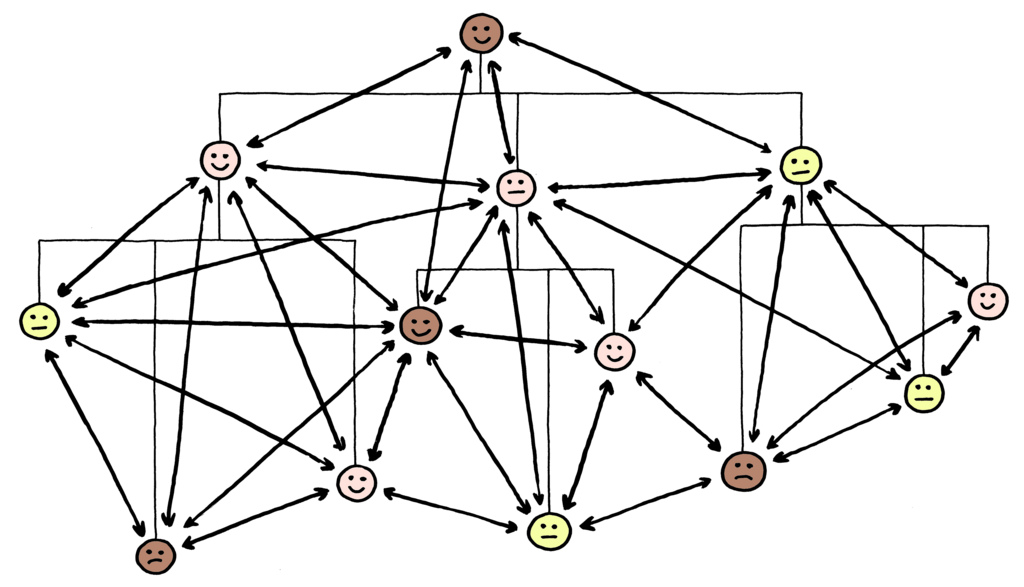
Image by Jurgen Appelo.
My two co-founders and I signed our first company into existence on a hot summer day in 2008. Prior to signing the document, we had to decide what our titles would be. Our lawyer assured us that we could give ourselves any titles we wanted and it would not have an impact on the legal process. We thought it would be fun to sport executive titles, so we each chose a grandiose executive title and then returned to our shared apartment and kept hacking.
After several years at both companies, only the CEO title stuck. Although we remember what job titles we each picked, they ended up being largely unimportant.
Size Does Matter
Organizations give titles to members to help people outside the organization understand who they are speaking with. When you get interviewed for a job, you want to make sure you aren't talking to a sales associate, you want so-and-so from HR. When a member of the press deals with a company, speaking with the CEO lends more weight than if the representative is a summer marketing intern.
But the orienting power of a title breaks down when the organization being represented is small. If you are being interviewed for a position at a 5 person startup, it's less important who you talk to because you can be more certain you are talking to someone of importance. Similarly, if a member of the press talks to one of a three person founding team, it matters less what title they chose and more that they are one of the co-founders.
For small startups, job titles are less important, if not entirely meaningless--except for the title of CEO.
Head Honcho
So why does the CEO badge remain important even at a tiny company? At both of my companies, we made it clear to our customers and business partners who we were, and we didn't made any attempts to look larger than we are. So at least in theory, an email from any one of us should have carried equal weight. Internally this was true, but externally, it remained useful to call one person the head honcho. Even in a super-small startup, it helps clarify to outsiders who the organization recognizes as the leader or point of contact.
None of us made business decisions without unanimous consent, we all checked each other's commits, and we all read each other's support emails. But startups deal with thousands of people in their lifespan and it's easier on everybody to avoid explaining egalitarian cooperation and simply point to one guy and say "he's boss."
This doesn't mean, however, that tiny startups can get away without a clear internal division of labor. Titles need not be assigned, but somebody has to know it's their job to file this year's tax return on time. At both of my startups, I was referred to as "head businesser." Nick was a "programmer," and Scott was a "programmer and accountant." The fact that Nick and Scott were labeled CTO and CFO on paper was only superficially important. Their understanding of their roles at the company, however, was of paramount importance.
Conclusion
If you are starting a startup and are wondering whether you and your cofounders should have titles, I would give this simple advice: decide who the CEO is and stop worrying about other three letter acronyms. Incidentally, this is exactly the advice that YCombinator tells it's founders.